There is one thing I particularly disdain, perhaps because I am a stereotypical European philosopher: It is what the Germans call _Etikettenschwindel_ or a _Mogelpackung_. False labelling. You buy something because the package tells you that what you want is supposedly inside, only to discover that the contents bear little resemblance to the branding outside. In most civilized parts of this world - e.g. Japan or Europe - this kind of practice is frowned upon and illegal.
But there is of course _american exceptionalism_: In the USA nowadays you will find “cheese” whose relationship with [cheese sometimes appears rather metaphysical](https://www.delish.com/kitchen-tools/a64817402/what-is-american-cheese/). Or [lemonades dyed lurid colors](https://www.reddit.com/r/Damnthatsinteresting/comments/137rrvk/the_colour_difference_between_american_and/) to create the impression of containing fruits. Of course there is also a sport called “football”, in which the foot has surprisingly little contact with the ball in question. And for some weird reason, left-wingers are called liberals.
Looking at how things have been going the past decade since 2016 and how they are heating up now in the middle of the second Trump presidency, America even has a Republican Party containing remarkably little republicanism, if any at all. Actually, if you look inside the _GOP_, I suspect that you will find not even trace amounts, but simply no Republicans at all in the so-called Republican Party.
Unlike with cheese, political words and branding do matter on an existential level even if you are a culinary ignoramus, especially in this case. _Republicanism_ is one of the greatest, most fundamental and most nobel ideas of European and wider Western Civilization. I myself am a passionate European Republican. It pains me to see the disgrace taking place on the other side of the Atlantic taint and slander the word _republican_, which stands for a way of thinking and a passion much older, more virtuous and much more venerable than Donald Trump or the United States of America themself.
But what, then, is _Republicanism_, if not what the Republican Party stands for and does? The slightly amusing and at the same time very sad answer is, that it is increasingly the opposite of what the GOP and USA stand for today. And the opposite of a Republican is not a _Democrat_. To understand why, we have to go back in history, to a time when the United States did not yet exist, and then a bit further still, to one of the founding figures of european civilization, to the first _Republican_.
His name was Lucius Iunius Brutus.
Being a Republican means being a disciple of the two Brutii, who were the first and last Republicans of the Roman Republic. And this is something, today’s so-called Republicans seem to have forgotten.
# The First Republican
[
](https://substackcdn.com/image/fetch/$s_!a5_F!,f_auto,q_auto:good,fl_progressive:steep/https%3A%2F%2Fsubstack-post-media.s3.amazonaws.com%2Fpublic%2Fimages%2Fcb9fe25d-96f7-49e9-b86c-4b1acd1e5df6_878x700.jpeg)
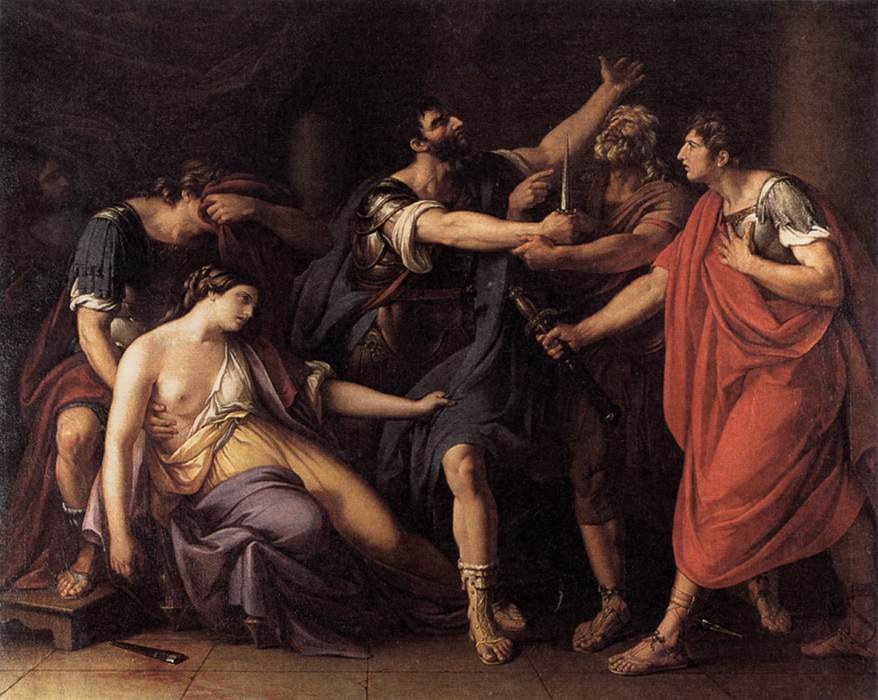
The Death of Lucretia by Gavin Hamilton, 1763
If one believes the myth, the first Republic was born out of a rape, that sparked a revolution.
Two and a half millenia ago, around 509 BC, the city of Rome was ruled by a King. That king was Tarquinius Superbus and he had among others a son, a Prince named Sextus. This prince Sextus became obsessed with Lucretia, a Roman noblewoman. As she rejected his flirtations and advances, Sextus decided to do as Princes and Kings have done for millenia before and after, to use his power and just take what he wanted: he raped her. One night he entered her bedroom armed with a sword and threatened not merely to kill her if she resisted, but to also murder the slaves beside her aswell. Lucretia submitted and suffered.
The following day Lucretia summoned her family and friends, and told them what the prince had done and demanded that they swore vengance. Her family and friends attempted to console her: the crime belonged to the perpetrator, not to her, the person upon whom it had been inflicted. Lucretia nevertheless declared that she couldn’t bear to continue living. She drew a dagger from beneath her clothing and stabbed herself through the heart.
While her family was staggered by schock, one of their trusted friends, Lucius Iunius Brutus stepped up and pulled the dagger from Lucretia’s body. Holding the weapon still dripping with her warm blood, Lucius swore that he would enact not only vengance for Lucretia, but also make sure that no tyrant, no king or prince, would ever be able to do something like this every again.
The other witnesses of Lucretia’s suicide, her husband and her father among them, joined into the oath, and many more followed. The oath spread. Lucretia’s corpse was carried trough the city and rallied the people of Rome around her.
The people of Rome, enragd by Lucretia’s death and led by Lucius Iunius Brutus banished Tarquinius Superbus, the last King of Rome, into exile. The monarchy was abolished. The Romans vowed that never again should one family stand above the political community and possess a form of power from which ordinary citizens cannot adequately protect themselves; never again should a prince believe to be allowed to rape.
After wrestling the power from the monarch tyrants personal grip, Brutus therefore did not take the power to himself. He did not make himself the new king, but he did something very radical and very noble: He gifted the power away, divided it and made it a “public thing”, a _res (thing) publica (public),_ belonging to the citizens of Rome. He created offices and checks and balance with the Consulship. The first Roman Republic was born and with it the idea of Republicanism, of liberty as being free of arbitrary domination and of power being owned by the public.
The gift of Lucius Brutus to the Romans came at a terrible personal cost. Briefly after establishing the Republic, Brutus discovered that some young aristocrats were conspiring to bring the king back. Among the conspirators were two of his own sons, Titus and Tiberius. Brutus could have pleaded for them, bent the rules, or simply decided that family loyalty outranked his public duty to the newly created Republic. Instead, according to Livy’s famous account, he condemned his sons together with the other conspirators for their treason to death and watched their execution. That conviction that the _res publica_ had to stand and indeed stood above the clan was reaffirmed by its founder with not only the blood of the tyrant, but also with his own.
# The first principle of Republicanism
In the myth of Lucretia and Lucius Brutus lies the first principle of republicanism: power should not be the private property of kings, but be publicly owned by the citzens; the state should belong to no one, but to every citizen. Cicero defined the _res publica_ therefore also as a _res populi_, a thing of the pople, a property of the people, and a people not as any crowd, but as citizens bound together by a shared law and a common good. For a Republican who wants to live in a Republic, power does not belong to a king, a president, a dynasty, a billionaire or a party, but it has to be carefully dispersed across society and institutions. The Romans called the condition this secures _libertas_, from _liber_, free. To be free meant to be a citizen and not a slave: not merely to be left alone, but to live in ways where no one holds arbitrary power over you.
The Republicans of Rome also recogonized that a constitution cannot safeguard liberty by itself, as I already wrote in my essay [_The Education of a European Liberal_](https://nikodemskrobisz.substack.com/p/the-education-of-an-european-liberal). Freedom demands a character befitting the free, _liberalitas_, which Cicero called the bond of human society: a generous disposition of citizens toward one another and toward the common good. Its opposite, _illiberalitas_, was the conduct unworthy of a free man, defined above all by greed and meanness. Whoever lived only for his own profit and pleasures acts like a slave, whatever his legal status. Brutus, who toppled a tyrant and gave away the kingdom, practised that virtue on the grandest scale. He is the first and truest embodiement of the virtues of _liberalitas_, the archetypical liberal Republican, who refuses to bow to tyrants, but also is willing to sacrifce and do what it is necessary to maintain the liberal order.
# The Last Roman Republican
The Roman Republic did not last eternally. Almost five centuries after Lucius Brutus founded it, roughly twice as long as the USA’s republic has existed so far, monarchy returned to Rome. Brutus’s oath still held such power that its Rome’s new tyrants never dared to call themselves kings. Instead they took on the name of the man who destroyed the Republic. When a crowd once hailed him as _rex_, Iulius Gaius Caesar is said to have replied that he was not a _King_ but a _Caesar_. Thus _Caesar_ became the title of Rome’s emperors, and in time the very word for the supreme monarch across Europe, _Kaiser_ in German, and _Tsar_ in Russian.
But: Caesar was not a tyrant of the old kind, not a hereditary monarch, but something far more familiar to us today: an authoritarian populist, not much different from the type that haunted the 20th century in the forms of Lenin, Mussolini and Hitler.
Caesaer rose as a _popularis_, a populist politician who went around the Senate by appealing directly to the crowd, promising land, grain, debt relief and revenge on a corrupt aristocracy. While he played the poor man’s advocate, Caesar allied himself with the richest man in Rome, the oligarch Marcus Licinius Crassus.
The resemblance to the authoritarian populists of the 20th and 21st century extends to mass murder. Caesar made his name and his fortune conquering Gaul, where ancient writers put the dead at around a million. If those figures are even roughly right (and they rest largely on Caesar’s own reports), he killed something like 10% - 25% of the population in Gaul at that time. That is a share approaching the Khmer Rouge’s toll in Cambodia or the Holodomor in Ukraine, and far beyond what Stalin’s terror purges inflicted upon the people of the Soviet Union. In his own _Commentarii de Bello Gallico_ Caesar cooly describes the genociding of the Eburones. When he seized the envoys of the Usipetes and Tencteri during negotiations and then slaughtered their people, women and children included, the Senator Cato proposed in the Senate that Caesar be handed over to the Germanic tribes for his war crimes. The Republic still had men who had a moral compass and dared to call a war criminal out, but unfortunatley it no longer had the power to stop him.
Instead of giving up his command and facing the courts in 49 BC, Caesar crossed the river Rubicon with his army and started a Civil War against the Republic, which he won. By early 44 BC he had been named _dictator perpetuo_, dictator for life. He didn’t call himself King, but the Romans understood, that he had become one in everything but name.
Someone scrawled on the statue of Lucius Iunius Brutus: _if only you were alive_. Anonymous notes appeared at the tribunal of the praetor Marcus Iunius Brutus, who claimed descent from the man who had expelled the kings: _Brutus, are you asleep?_ and _You are no true Brutus_.
On the Ides of March, 44 BC, Marcus Iunius Brutus and Gaius Cassius Longinus and their fellow conspirators stabbed Caesar to death at a meeting of the Senate.
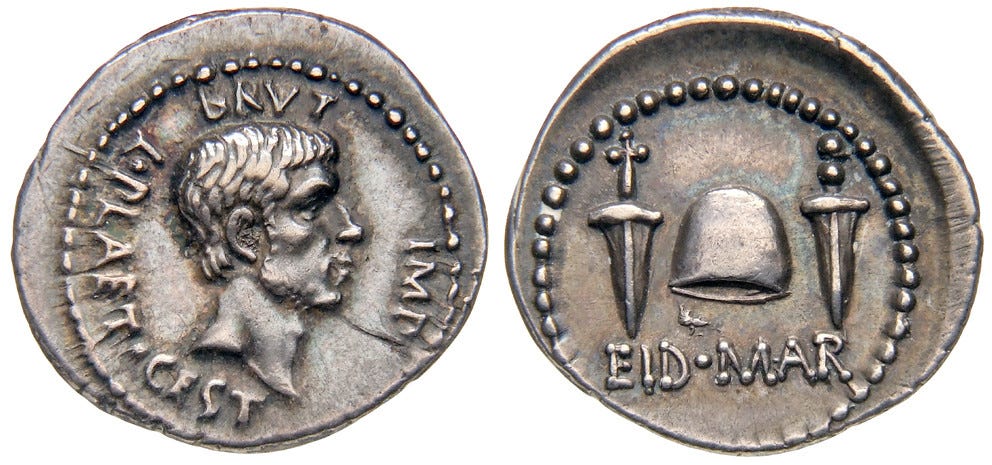
The first Republican Lucius Iunius Brutus had banished a king; the last Roman Republican, his grand-grand-grand… grandson, Marcus Iunius Brutus drove a dagger into the man who was becoming a new king. Brutus later ordered the minting of coins to celebrate the deed: the pileus, the cap given to freed slaves, between two daggers, above the words _EID MAR_, the Ides of March. Thus republicanism acquired symbols like a civic religion: its sacred word was _libertas_, its founding story the stabbing of the wannabe-king, and its relic the dagger and the cap of the freed slave.
[
](https://substackcdn.com/image/fetch/$s_!Ro_M!,f_auto,q_auto:good,fl_progressive:steep/https%3A%2F%2Fsubstack-post-media.s3.amazonaws.com%2Fpublic%2Fimages%2F57e46117-4836-4d51-8d2c-9548bca81c40_992x465.jpeg)
The coins of Marcus Iunius Brutus
And yet the dagger came too late, the Senators had stabbed Caesar too late. The Republic’s institutions were already hollowed out by populism and war, and Caesar’s death did not restore liberty; it opened another round of civil war between Caesar’s heir Octavian and the Republic. In 42 BC at Philippi, Brutus’s army was defeated and he took his own life. Shortly before, mourning his co-conspirator Cassius, he had called him the last of the Romans. The title fits Brutus himself. Octavian became Augustus and preserved the forms of the Republic as a facade while ruling as a monarch in all but name. The Roman Republic fell and centuries of despotism and decline began for Europe for many centuries.
There are many lessons to be learned from the Rise and Fall of the Roman Republic.
# The Cult of the Brutii in Paris
The Roman Republic fell, but the republican idea survived it. While with Caesar a dark age began for most of the continent, republican liberty resurfaced and survived in small pockets across Europe, for example with establishment of the Republic of Venice in 697 or the founding of the Swiss Confederation in 1291. And finally, after over a millenium and a half of darkness, the renaissance and enlightenment philosophers and then revolutionary France consciously resurrected both the idea of a Republic and the mythological heroes founding the first European, the Roman Republic on a large scale. Lucretia and the two Brutii became the mythical heros of the Revolution, of Liberty, Fraternity and Equality.
In 1789, the summer the Bastille fell, the painter Jacques-Louis David exhibited _The Lictors Bring to Brutus the Bodies of His Sons_, the artwork I also chose to illustrate this essay. It depicts the scene of sacrifice: Brutus sits alone in shadow while the women of his household collapse in grief. It is not cheerful propaganda, but it reminds the viewer of the cost at which the first proto-liberal, republican order was established. Voltaire’s tragedy _Brutus_ was revived in Paris to wild applause. Busts of Brutus presided over revolutionary assemblies, and parents named their sons after him. Even the cap of the freed slave on Marcus Brutus’s coin returned, as the red bonnet of liberty.
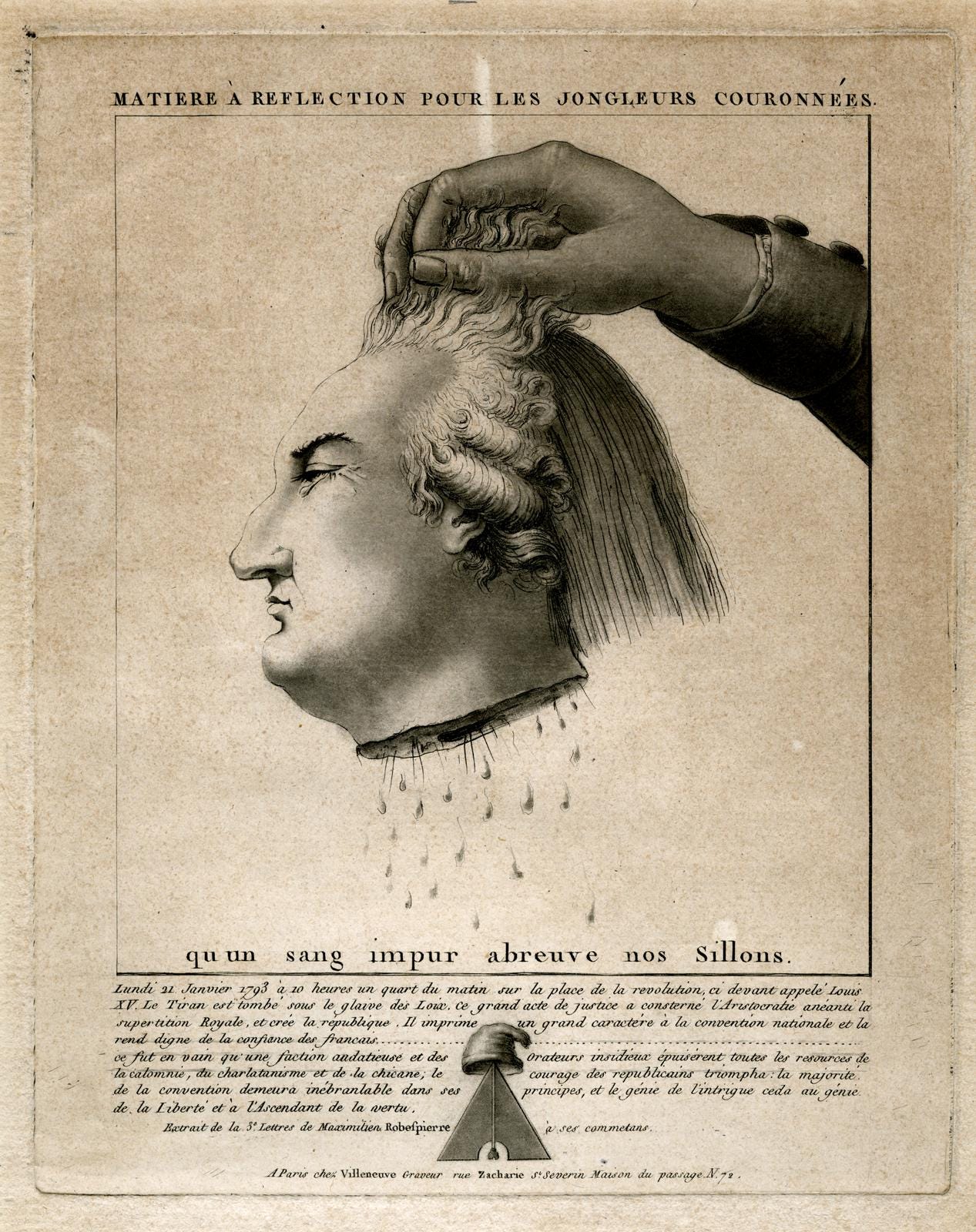
The French people were not just doing some Roman LARP. When France abolished its monarchy in 1792, King Louis XVI ceased to be the sacred embodiment of the nation and became merely Louis Capet: a citizen answerable to his fellow citizens for his crimes and abuses of power. He was tried, and on 21 January 1793 he was guillotined. The french people followed the conviction of Brutus: _No more kings_.
[
](https://substackcdn.com/image/fetch/$s_!WPmH!,f_auto,q_auto:good,fl_progressive:steep/https%3A%2F%2Fsubstack-post-media.s3.amazonaws.com%2Fpublic%2Fimages%2Fdd050be5-c6d2-48e8-a275-b0d48a482357_1267x1600.jpeg)
“Something to reflect upon for crowned jugglers” - French revolutionary satire with the severed head of Louis XVI held aloft. January/February 1793
While the French Revolution gave new life to the ideal of the Roman Republic and revived the cult of the Brutii, Republicanism, it also speed-run at an almost tragi-comical pace the sad fate of the Roman Republic. In 1804 Napoleon Bonaparte crowned himself emperor. Within a single generation France had produced its Brutii, established its Republic and then succumbed to its Caesar, leading it to empire and collapse into tyranny again.
# Brutus crossing the Atlantic
Across the Atlantic, the cult of the Brutii took a gentler and more successful form. In 1782, with the war against the British Crown all but won, an officer named Lewis Nicola wrote to George Washington suggesting that he become king. Washington replied that the idea filled him with abhorrence and told Nicola to banish such thoughts from his mind.
In 1783, instead of using a restless army to seize power, Washington resigned his commission to Congress and went home. George III reportedly remarked that if Washington did so, he would be the greatest man in the world. Contemporaries compared Washington to Cincinnatus, the Roman who laid down his dictatorship and returned to his plough.
And Washington did exactly this. After two terms as president, he stepped down in 1797, although he could almost certainly have been re-elected for life. The custom he founded doing so held for nearly a century and a half. After Franklin Roosevelt broke it in 1940, the Americans wrote it in 1951 into their Constitution as the 22nd Amendment.
The Founding Fathers of the USA built the US Constitution on a republican distrust of mastery, very much inspired by the learnings from the Roman Republic: executive against legislature, House against Senate, states against the Union, courts against all of them. _Ambition must be made to counteract ambition_, Madison wrote, echoing similiar ideas from the renaissance republican Machiavelli. The point of the republican government was never efficiency. Kings are wonderfully efficient. The point was to make mastery and tyranny impossible.
For the past two hundred years the USA were, despite all its flaws, the purest instantiation of the Republican idea, a beacon of liberty, especially as Europe struggled again and again against monarchs, dictators and populists at the same time.
# The Republican Party
The grand old Republican Party was born from a cause worthy of this inheritance. Founded in 1854 to stop the expansion of slavery, and soon led by Abraham Lincoln, it fought the most literal negation of republican liberty imaginable: one human being owned by another.
And while the Republican Party lost it’s ways over time, especially under Nixon, the Republican ideal was still alive in it for much of the 20th century. Ronald Reagan for example understood liberty as an inheritance each generation must earn anew: freedom, he warned, “is never more than one generation away from extinction”. When Poland’s communist regime declared martial law to crush Solidarność in December 1981, Reagan imposed sanctions on Moscow, lit a candle in a White House window for the Poles and asked his fellow Americans to do the same. The Reagan administration helped keep the outlawed democratic movement alive with money, printing presses and radio equipment. In London he predicted that [the authoritarian and populist cancer of Marxism-Leninism would end on the ash heap of histor](https://www.reaganlibrary.gov/archives/speech/address-members-british-parliament)y; in Berlin he demanded that Gorbachev tear down the wall. Between the strikers of Gdańsk and the master in the Kremlin, he never hesitated over which side a free man belongs on. And after eight years in office Ronald Reagen honored the tradition and the consitution and went home to his ranch. Reagan never believed that he was America, or that an institution resisting his power was therefore its enemy.
# MAGA
[

](https://substackcdn.com/image/fetch/$s_!TTZ6!,f_auto,q_auto:good,fl_progressive:steep/https%3A%2F%2Fsubstack-post-media.s3.amazonaws.com%2Fpublic%2Fimages%2F0282ba72-6618-419c-b889-c477feda8c17_658x418.jpeg)
an AI generated picture of the US president and vice-president as kings, posted by the White House X account in response to the “No Kings” rallies, captioned “We’re built different.” on October 19, 2025, the day after nearly 7 million people protested.
Measured against the old republican tradition, MAGA appears like a sad mockery, a tragic and grotesque parody.
In August 2026 Congress passed sweeping new sanctions on Russia, 86 to 11 in the Senate, and Trump signed them. A few weeks later he waived them by executive order, a week after announcing a deal to buy Russian diesel. Three days after that, a Russian drone struck a park in Ukraine’s Kharkiv region and killed a fourteen-month-old girl in her stroller. Her mother died in hospital. The same day, Trump told reporters that “Russia, frankly, has been fine on Ukraine. They haven’t been doing much”. Two days later his envoy Steve Witkoff sat across from Vladimir Putin in St. Petersburg and called him a humanitarian. Reagan lit a candle for the people resisting the Kremlin and sent money and resources to combat authoritarianism across the globe, to free it from the communist grip. Today’s Republican leadership pays the Kremlin compliments.
The Brutii fought kings; Lincoln fought slavery; Reagan fought the tyrants in Moscow. MAGA daydreams about subjugating America under the grip of a new King. In February 2025, cheering his move against New York’s congestion pricing, Trump posted “_LONG LIVE THE KING!_”, and the White House Social Media accounts illustrated it with a mock magazine cover of him in a crown. Days earlier he had posted that “_He who saves his Country does not violate any Law_”, a line usually attributed to Napoleon, who betrayed the republican ideals of the French Revolution and crowned himself Emperor. Trump also has said repeadetly that he is “not joking” about the third term the Constitution forbids. Trump 2028 hats are handed out at the White House as souvenirs, while he concedes the 22nd Amendment is “pretty clear” and calls it “too bad”.
Then there is Lucretia. Roman republicanism begins with the people rising up against the sexual predation of a Prince. In 2023 a New York jury found Trump liable for sexually abusing E. Jean Carroll and then defaming her. The presiding judge explained that what the jury found amounted to rape in the ordinary sense of the word. In 2026 the Supreme Court declined to hear Trump’s appeal and then refused to reconsider. The GOP’s response has not been revolt, but a tighter embrace. The party named after the tradtion founded by Lucius Brutus has arrived at an extraordinary destination: its founding myth begins with a prince’s rape infitoppling a monarchy, while its present cult surrounds making king a rapist, who not only has been convicted of sexual abuse himself, but has been for long friends with Jeffrey Epstein.
Trump and Jeffrey Epstein were friends for years; photographs, videos, flight logs and Epstein’s address book document it, and the Epstein files released since December 2025 mention Trump more than 38.000 times despite the censoring.
A true Republican should instinctively recoil from the worlds of the Epstein class, of private impunity. The Romans answered the rape of a single women by a Prince with a revolution. Too many Americans are answering the mass rape of countless women by the ruling elites of the USA today with a shrug.
The same inversion runs through the relationship between power and family. Lucius Brutus executed his own sons rather than let his family stand above the rule of law of the Republic. Trump folds his family into power: Ivanka Trump and Jared Kushner held influential White House roles in the first term, and Lara Trump went on to co-chair the Republican National Committee. Not to mention the myriad ways the Trump family and their cronies have already used the presidency to enrich themselves, from selling merch, to taking bribes to selling memecoins.
The intellectual fringe of the GOP makes the perverse inversion of the republican values explicit. Curtis Yarvin, the most articulate theorist of the American post-liberalism and neo-monarchism tainting the Republican Party today, imagines the state as a corporation run by a sovereign chief executive. The movement is almost perfectly symmetrical to Brutus’s. Brutus took power away from the king’s household and made it a public thing. Yarvin would love to take it private again. And like Rome’s First Triumvirate, the coalition joins populist charisma with vast private wealth. Elon Musk is not Crassus, and Trump is not Caesar; but something here rythms with history. Liberty, as Machiavelli and Madison pointed out, lives in the standoff between powers that keep each other in check. Whoever fights the tyranny of government while serving the tyranny of oligarchs is not liberty’s friend, but the next master’s herald.
This is why the opposite of a Republican is not a Democrat. It is a courtier: a man free by law who chooses to behave like a slave, to exhibit the trait the Romans called _illiberalitas_. It is the courtier, who asks what the ruler can give him. It is the tribesman, who asks whether the ruler is one of us. It is the partisan, who asks whether power can be turned against the other side.
A true republican asks the uncomfortable questions: why should this person hold such power at all? He must ask it most insistently when the leader belongs to his own faction, because opposing the tyranny of one’s enemies requires very little virtue.
The old republicans raised the dagger because they despised the master. The new cult adores him. The GOP inherited Brutus and acquired a taste for Caesar. It kept the name of the tyrant-slayers and became a court of bootlickers.
# A Brutus for Europe
There is a European lesson in all this. Despots have tried to unite Europe many times: Roman emperors, Charlemagne, Napoleon, the dictators of the 20th century. In every one of those attempts to unite Europe, that united Europe belonged to someone, be it a party, tribe or a crown, and every one of them fell apart and ended in catastrophy. A Europe owned by a master, a dynasty, a party or a technocratic caste, not to speak of racist fanatics, will never hold together. The only union that can last and prosper is one that belongs to its citizens. If Europe is to unite successfully, it will do so as a republic, or not at all. Furthermore, only a European federal republic would be able to defend liberty against the empires and oligarchs around it.
That is why we need to revive the cult of the Brutii. Not necessarily the cult of the daggers: our civilization has learned, at enormous cost, to replace the dagger with the ballot, assassinations with impeachments, revolts with judicial review and referendum. These procedures seem dreary, but they can work; beneath them lies the same moral order Brutus swore to over Lucretia’s body: power exists beneath liberty, not liberty beneath power. Institutions alone will not defend it. Rome had a constitution too. It fell when its citizens lost their _liberalitas_, when enough of them preferred the gifts of a Crassus and the promises of a Caesar to the burdens of freedom.
[
](https://substackcdn.com/image/fetch/$s_!H5YM!,f_auto,q_auto:good,fl_progressive:steep/https%3A%2F%2Fsubstack-post-media.s3.amazonaws.com%2Fpublic%2Fimages%2F29372f85-57d6-4e82-9ac7-1da99ad399c3_954x1212.jpeg)
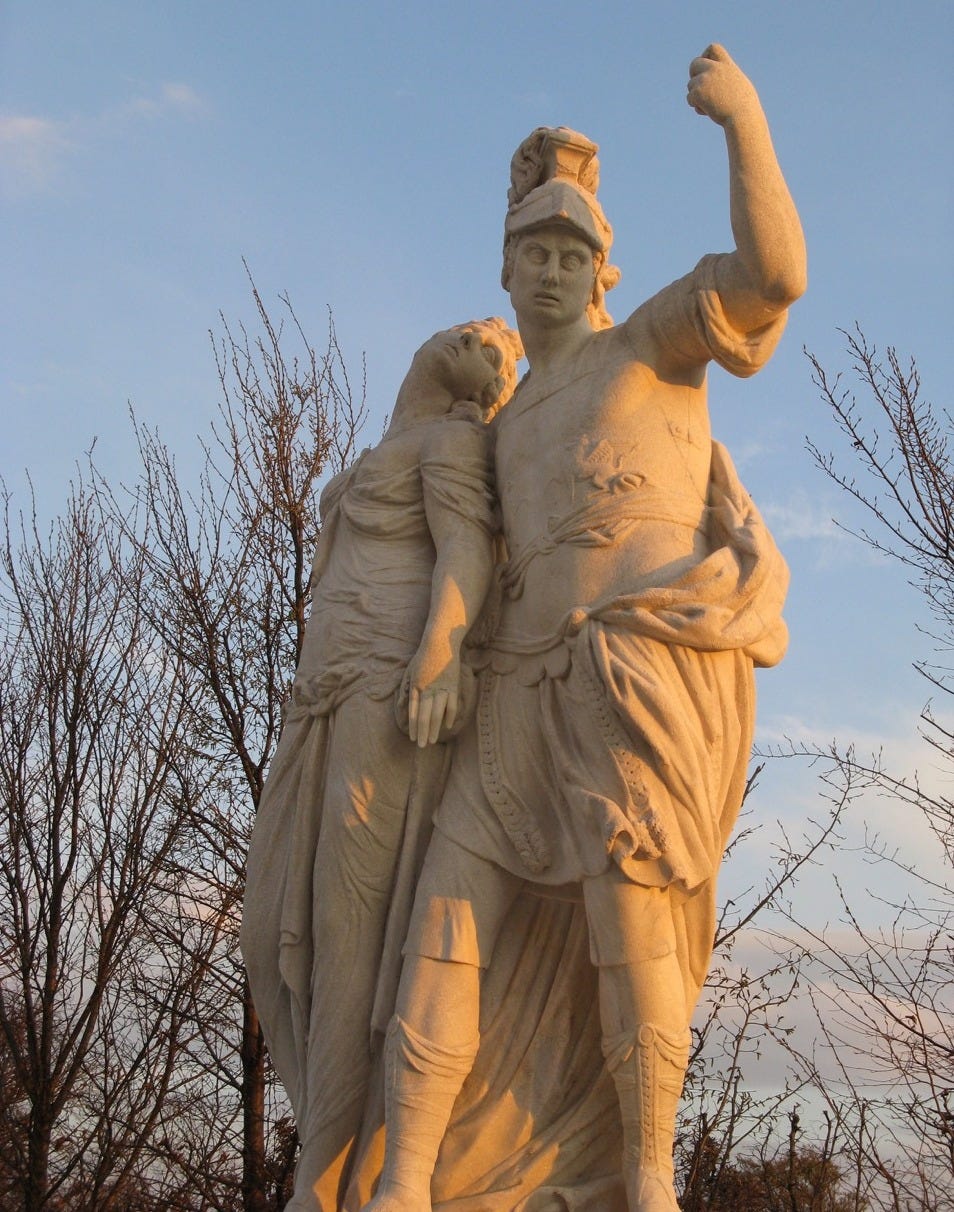
Statue of Iunius Brutus, swearing revenge at Lucretia's corpse, by Ignaz Platzer at Great Parterre, Schönbrunn (1777)
If our continent is ever united in the kind of European Federal Republic I envision, I would want a statue of Lucius Iunius Brutus before its central institutions, not hidden among broken marble in a museum, but outside, where presidents, parliamentarians, judges and citizens pass beneath his gaze every day. Lucretia should stand beside him, because the Republic’s story does not begin in a constitutional convention but in the most intimate abuse of arbitrary power imaginable: a powerful man’s belief that somebody else’s body exists for his appetite. And Marcus Brutus should stand there too, as a warning that a republic which waits for the dagger has already waited too long to act.
These statues would also rebuke every future populist and demagogue telling us that politics would be easier or better if citizens agreed to become customers of a sovereign corporation or servants of a king. Of course it would be easier. Free people are notoriously difficult to rule. But as Ronald Reagen put it: “[_You and I know and do not believe that life is so dear and peace so sweet as to be purchased at the price of chains and slavery._](https://www.reaganlibrary.gov/archives/speech/time-choosing-speech)“
Europeans should not feel smug. Our continent has its own Caesars in waiting, both home grown and sponsored by our enemies in Moscow and Mar-a-Lago, and its own courtiers.
Rome left us a double lesson: liberty can be gained as republics can be founded, and liberty can be lost as republics can die. If Europe ever unites it one Republic worthy of the name, Lucretia and both Brutii should watch over it, to remind us how republics are born and how they are lost so that we too do not have to repeate the mistakes of the past.
As the Americans are heading to the ballots in the midterm elections on tuesday, I do hope they too remember to not repeat the mistakes of the past.